

What Does the Latest Research Tell Us About Myopia-Control Glasses?
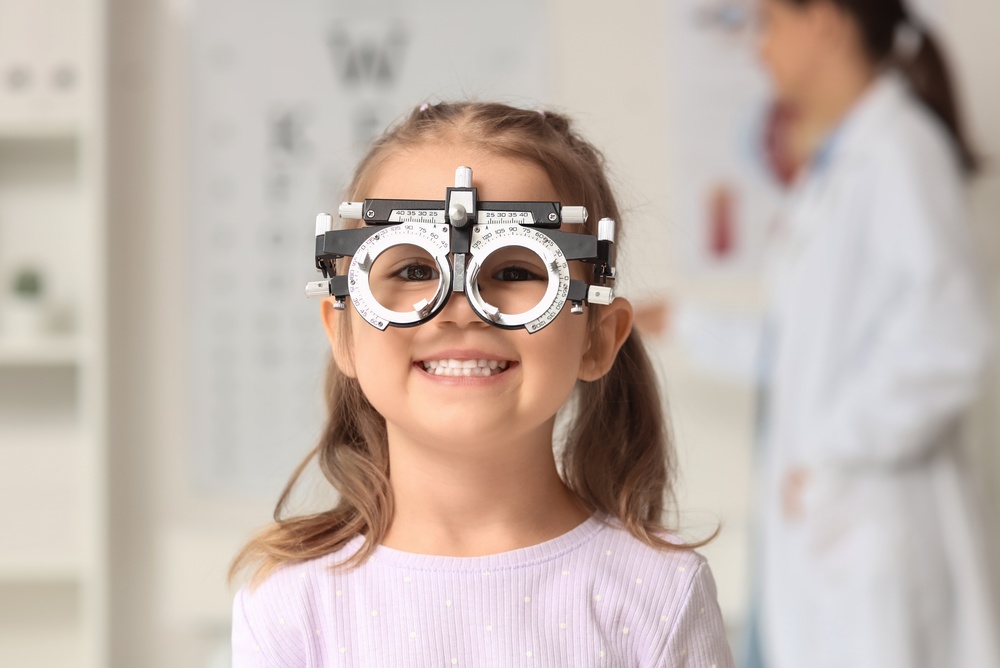
When a child becomes nearsighted, the traditional approach has been: prescribe glasses so they can see clearly. That is what happened to me and almost all adults my age (50s). Today, we know that there is another important question to ask:
Can we also slow the progression of myopia?
Myopia management has become an important part of pediatric eye care, with several treatments available to help slow the growth of the eye that we talk about every single day. These include specialty spectacle lenses, contact lenses, orthokeratology and pharmaceutical treatments such as low-dose atropine.
A new 2026 review published in Optometry and Vision Science provides an interesting look at one of these approaches: spectacle lenses using highly aspherical lenslet, or HAL, technology. These lenses only became commercially available in the USA in 2025 as Stellest lenses. Since that time we have dispensed hundreds of these lenses.
Why does slowing eye growth matter?
When we talk about myopia, it is easy to focus on the prescription. That is the thing we call know. A child might go from -1.00 to -2.00, for example, and we can measure that change with a refraction.
But there is another measurement that is particularly important: axial length.
Axial length is the distance from the front of the eye to the retina. As a child becomes more myopic, the eye commonly becomes longer. Excessive axial elongation is important because higher levels of myopia are associated with greater lifetime risks of conditions such as retinal detachment, myopic macular degeneration and glaucoma.
That means modern myopia management is not simply about helping a child see clearly today. It is also about trying to reduce the amount of myopia that develops over the course of childhood.
What are highly aspherical lenslets?
HAL spectacle lenses look much like ordinary glasses, but the lens contains thousands of tiny optical elements arranged in concentric rings outside a central clear area.
The design is intended to provide clear central vision while simultaneously creating a pattern of myopic defocus in front of the retina. This optical signal is thought to influence the mechanisms involved in eye growth.
The precise biological mechanism is still being investigated. Researchers continue to study whether the effect comes primarily from myopic defocus, changes in contrast, or a combination of optical effects.
In other words, we have good evidence that the lenses can slow eye growth, but we are still learning exactly why.
What does the new research show?
The 2026 review by Olga Prenat and Mark Bullimore looked beyond the original clinical trials and examined the growing body of research on HAL lenses.
The authors identified 26 independent studies involving 4,079 children who wore HAL lenses for at least six months. Seventeen of the studies were conducted in China, with additional studies from Europe, Singapore, India and Vietnam. The studies included randomized clinical trials, prospective studies and retrospective real-world studies.
The most consistent finding was that children wearing HAL lenses experienced less axial elongation than children wearing conventional single-vision spectacles.
Across studies that included a single-vision comparison group, the median one-year axial elongation was 0.12 mm for children wearing HAL lenses compared with 0.32 mm for children wearing single-vision lenses.
That is a small difference in absolute terms, but eye growth is measured in very small increments. Over several years, those differences are huge.
What happened in the original clinical trial?
The strongest evidence comes from the randomized clinical trial that originally evaluated HAL lenses.
Children were assigned to HAL lenses, slightly aspherical lenslets, or conventional single-vision spectacles. After two years, average axial elongation was:
- 0.34 mm with HAL lenses
- 0.51 mm with slightly aspherical lenslets
- 0.69 mm with single-vision lenses
The corresponding changes in myopia were -0.66, -1.04 and -1.46 diopters, respectively.
The children in the HAL group wore their glasses an average of about 12.9 hours per day. Importantly, the study also found a relationship between wearing time and treatment effect. Children who wore the lenses for at least 12 hours per day experienced an even greater reduction in progression.
This highlights something that applies to virtually every form of myopia management: The treatment has to be used consistently to have the best opportunity to work.
What about longer-term results?
Long-term data are especially interesting because myopia is a childhood condition that can progress for many years.
Some children from the original clinical trial continued wearing HAL lenses and were followed for five years. Among the original HAL participants who completed the five-year visit, average axial elongation was substantially lower than the amount estimated for a modeled single-vision comparison group.
There is an important caveat here: the five-year comparison was not a five-year randomized trial. The single-vision comparison was estimated using a model based on the earlier trial data. That makes the five-year findings encouraging, but they should not be interpreted with the same confidence as a randomized five-year comparison. This distinction matters.
How do myopia-control glasses compare with other treatments?
HAL lenses are only one tool in the myopia-management toolbox.
The review also examined studies comparing HAL lenses with other spectacle designs, overnight orthokeratology and combinations of HAL lenses with low-dose atropine.
The results are not completely uniform. Some studies found HAL lenses performed similarly to other myopia-control approaches, while others found differences. Comparisons with orthokeratology also varied between studies and patient groups. Combining HAL lenses with low-dose atropine appears promising in some studies, but the evidence for combination treatment is more limited and heterogeneous.
That is one reason we do not believe there is a single myopia-control treatment that is right for every child.
Age, rate of progression, amount of existing myopia, family history, lifestyle, binocular vision and other clinical factors can all influence the treatment discussion.
What are the limitations of the research?
Most of the 26 studies included in the review were retrospective rather than randomized clinical trials. The studies also differed in their populations, ages, follow-up periods and methodologies. The authors specifically note that additional high-quality randomized trials are needed.
There is also a potential conflict of interest worth mentioning. The review was funded by EssilorLuxottica, the manufacturer of the HAL technology, and some of the studies included industry funding or authors with industry relationships. The review authors disclosed these relationships and compared the results of industry-funded and other studies, finding no obvious systematic difference, although they noted that this was not a formal sensitivity analysis.
Again, this does not mean the results should be dismissed. It means they should be interpreted in the context of the entire evidence base.
What does this mean for parents?
Perhaps the most important message from this research is that myopia management is becoming an increasingly evidence-based part of children's eye care.
We now have multiple approaches that can slow the progression of myopia. Specialty spectacle lenses offer an especially interesting option for children who need glasses anyway, because they provide vision correction while also addressing eye growth.
But choosing a myopia-management strategy should be an individualized decision. At Bright Eyes, we look at the child's age, prescription, rate of progression, axial length when appropriate, family history, visual system and other risk factors before discussing treatment options.
Our goal is not simply to give a child a stronger pair of glasses every year.
Our goal is to help children see well today while doing everything reasonably possible to protect their visual health for the future.
The research discussed in this article is based primarily on the 2026 narrative review by Prenat and Bullimore, “Slowing of myopia progression by spectacles with highly aspherical lenslets,” published in Optometry and Vision Science. As with all medical research, individual results can vary and treatment decisions should be made in consultation with an eye-care professional.


OFFICE HOURS
| Monday | 9:00am - 5:00pm |
| Tuesday | 9:00am - 5:00pm |
| Wednesday | 9:00am - 6:00pm |
| Thursday | 9:00am - 5:00pm |
| Friday | 9:00am - 5:00pm |
| Saturday | By Appointment Only |
| Sunday | Closed |
OFFICE HOURS
| Monday | Closed |
| Tuesday | 9:00am - 5:00pm |
| Wednesday | 9:00am - 6:00pm |
| Thursday | 9:00am - 5:00pm |
| Friday | Closed |
| Saturday | By Appointment Only |
| Sunday | Closed |
© 2026 Bright Eyes Family Vision Care All rights Reserved. Privacy Policy Sitemap
Powered by
